
91短视频


Nuclear Medicine Technology
09142023_Health_Science _LOWres-122

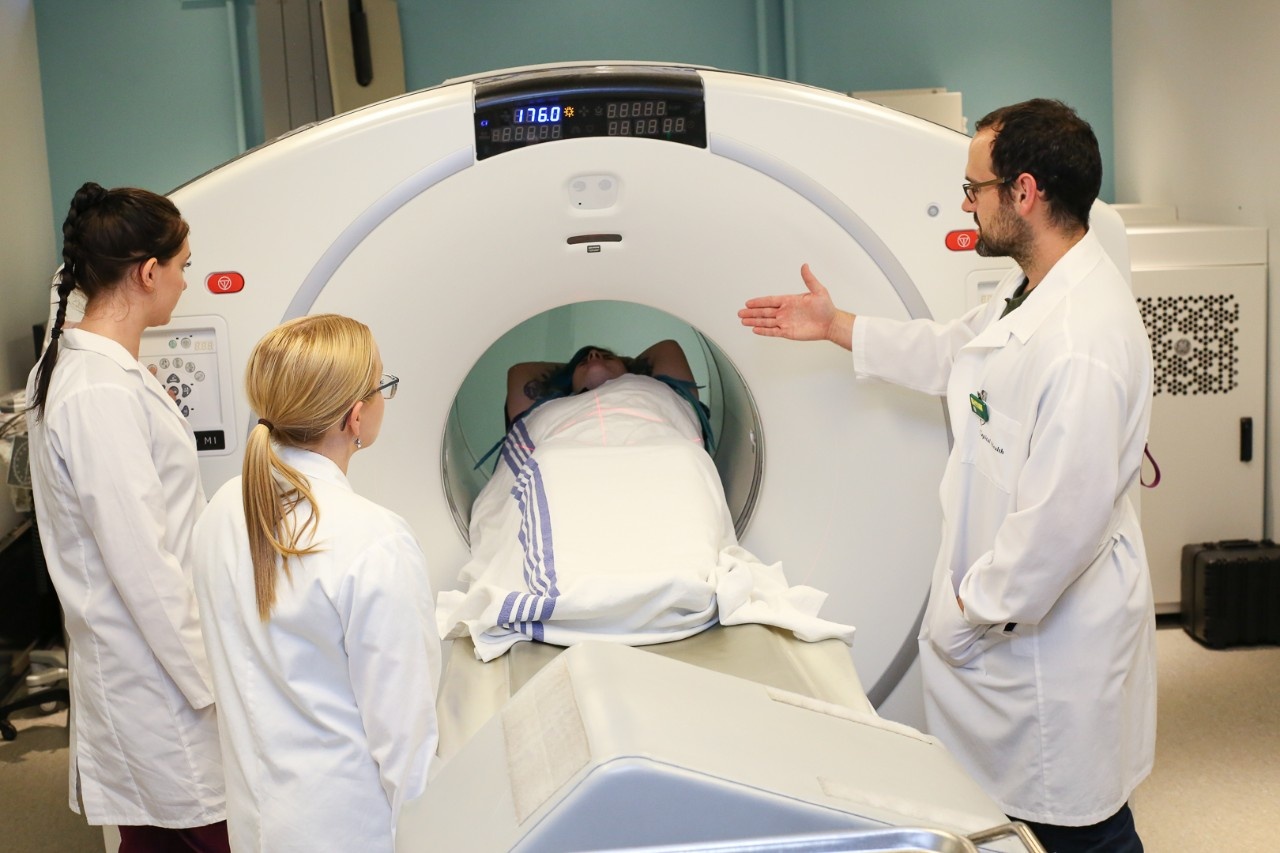
Nuclear Medicine Technologists are highly skilled health care professionals who use radioactive tracers called radiopharmaceuticals to help diagnose and treat a variety of illnesses. They see patients of all age groups, from newborns to older adults.

Nuclear Medicine Technologists may also be known as Medical Radiation Technologists (MRTs).

How does Nuclear Medicine Technology work?

Nuclear medicine is a specialized area of medical imaging and therapy that uses small amounts of radioactive materials, called radiopharmaceuticals, to diagnose and treat disease. Unlike many other imaging tests that primarily show anatomy, nuclear medicine evaluates how the body and its organs are functioning.

Nuclear Medicine Technologists are healthcare professionals specially trained to perform both diagnostic imaging procedures and therapeutic treatments using radiopharmaceuticals and advanced imaging equipment.

For diagnostic procedures, a radiopharmaceutical is introduced into the body, most commonly through an intravenous (IV) injection, although some tests may involve swallowing or inhaling the tracer. The radiopharmaceutical travels to specific organs, bones, or tissues, where it emits signals that can be detected by specialized imaging equipment such as gamma cameras, SPECT scanners, or PET/CT systems. These images help physicians diagnose disease, assess organ function, monitor treatment response, and detect abnormalities that may not be visible on other imaging tests.

Nuclear medicine can evaluate many areas of the body, including:

  • Bones
  • Heart
  • Kidneys
  • Liver
  • Thyroid
  • Brain
  • Parathyroid glands
  • Gastrointestinal tract
  • Lymphatic system
  • Lungs

Common diagnostic procedures include PET scans, bone scans, cardiac stress tests, thyroid scans, renal scans, and SPECT imaging.

In addition to diagnostic imaging, nuclear medicine technologists also perform therapeutic procedures that use targeted radiopharmaceuticals to treat certain diseases. These therapies deliver radiation directly to specific cells or organs while minimizing exposure to surrounding healthy tissues. Nuclear medicine therapies may be used to treat conditions such as hyperthyroidism, thyroid cancer, neuroendocrine tumors, prostate cancer, and some forms of bone pain associated with cancer.

Throughout both diagnostic and therapeutic procedures, Nuclear Medicine Technologists play an essential role in patient care. They prepare and administer radiopharmaceuticals safely, place IVs when needed, perform equipment quality control procedures, position patients correctly for imaging or treatment, and operate sophisticated imaging equipment to obtain high-quality results.

Nuclear Medicine Technologists are also responsible for ensuring patient safety, comfort, and radiation safety throughout the procedure. They explain the examination or treatment process, answer questions, monitor patients during the procedure, and provide aftercare instructions when necessary. They work closely with physicians, radiologists, and other healthcare professionals to help provide accurate diagnoses and effective patient care.

Where do Nuclear Medicine Technologists work?

Nuclear Medicine Technologists work in a variety of healthcare settings including hospitals or private clinics. They use highly technical equipment to perform the following types of procedures on all body systems:

  • General Nuclear Medicine
  • PET/CT
  • Computed Tomography (CT)
  • Interventional
  • Bone Density
  • Radiopharmacy
  • Cyclotron

Nuclear Medicine Technologists may also work in related areas:

  • Education
  • Research
  • Administration
  • Radiation Safety
  • Sales
  • IT


How do I become a Nuclear Medicine Technologist?

To become a Nuclear Medicine Technologist, individuals must attend and successfully complete an accredited Nuclear Medicine Technology program.

The School of Health Sciences offers a four year Bachelor of Health Sciences (BHSc) degree program, which includes theory and practice.聽

Graduates must write national registration exams and meet the clinical requirements set by the Canadian Association of Medical Radiation Technologists (CAMRT) in order to work. Those who pass the exam may use the designation "Registered Technologist in Nuclear Medicine" (RTNM).

91短视频's Nuclear Medicine Technology program curriculum offers the necessary competencies to challenge the Canadian Association of Medical Radiation Technologists (CAMRT) professional examination.

Is Nuclear Medicine Technology right for me?

Nuclear Medicine Technology can be an excellent career for people who enjoy healthcare, science, patient interaction, and advanced medical technology. It is a profession that combines technical expertise with compassionate patient care.

You may be well-suited for Nuclear Medicine Technology if you:

  • Enjoy working with people: Nuclear medicine technologists interact closely with patients throughout diagnostic and therapeutic procedures. Strong communication skills, empathy, and professionalism are essential, especially when working with anxious or seriously ill patients;
  • Are interested in healthcare and science: A strong interest in anatomy, physiology, radiation physics, and how the body functions is important. Nuclear medicine technologists must understand both normal and abnormal physiological processes;
  • Enjoy hands-on technical work: Nuclear medicine involves operating specialized imaging equipment such as gamma cameras, SPECT, PET, and CT systems, preparing radiopharmaceuticals, and performing imaging procedures safely and accurately;
  • Have a strong attention to detail: Small technical errors can affect image quality, radiation safety, and patient care. Accuracy and careful observation are critical in both imaging and radiopharmaceutical handling;
  • Can think critically: Nuclear medicine technologists regularly assess patients, adapt imaging procedures, troubleshoot technical issues, and recognize abnormal findings that may require immediate attention;
  • Work well under pressure: Healthcare environments can be fast-paced and emotionally demanding. Nuclear medicine technologists need to remain calm, adaptable, and professional during stressful situations, emergencies, or difficult patient interactions;
  • Value lifelong learning: Imaging technology, radiopharmaceuticals, and clinical practices continue to evolve. Successful nuclear medicine technologists are committed to ongoing learning and professional development

You may not be well-suited for Nuclear Medicine Technology if you dislike or find it difficult to:

  • Work closely with people who are sick, in pain, anxious, or emotionally distressed.
  • Pay close attention to detail for long periods of time.
  • Follow strict safety protocols and procedures consistently.
  • Handle radioactive materials responsibly and safely.
  • Work with needles, injections, and intravenous procedures.
  • Stand for long periods and assist with physically demanding patient care and heavy lifting.
  • Work independently while using strong clinical judgment.
  • Stay calm during emergencies, trauma situations, or when encountering serious diagnoses.

What are the essential skills and attributes of a Nuclear Medicine Technologist?

A strong nuclear medicine technologist combines technical expertise, clinical judgment, communication skills, and professionalism. The best technologists are not only skilled at performing imaging procedures, but are able to help patients feel safe, obtain accurate diagnostic information, and adapt effectively when clinical situations change.

Successful Nuclear Medicine Technologists have:
A strong understanding of anatomy, physiology, radiation physics, and imaging principles, along with technical proficiency in nuclear medicine procedures and imaging equipment. They demonstrate excellent critical thinking and problem-solving abilities, strong attention to detail, sound clinical judgment, and adaptability in fast-paced, changing healthcare environments.

Nuclear medicine technologists work closely with patients during vulnerable and sometimes stressful situations. Strong interpersonal skills help create a safe and supportive experience for patients. A nuclear medicine technologist should be empathetic and compassionate, possessing the emotional intelligence to recognize and respond appropriately to patient needs, concerns, and emotions. They must maintain professionalism during stressful situations and communicate clearly and effectively with both patients and healthcare teams.

It is also essential that nuclear medicine technologists demonstrate professional and ethical practice, including a strong commitment to radiation safety, patient confidentiality, and quality patient care. They should be reliable, organized, and capable of working independently while collaborating effectively within a multidisciplinary healthcare team.

Finally, successful nuclear medicine technologists are committed to lifelong learning and ongoing professional development. Advances in imaging technology, radiopharmaceuticals, and hybrid imaging continue to shape the profession, requiring technologists to remain current, adaptable, and resilient under pressure.

For further details, please review the .


Entrance Requirements

To be considered for admission, High School applicants require grade 12 academic English, Math, Physics and Chemistry with no mark below 70% in each of these courses and an overall minimum average of 75%. Post-secondary applicants require a minimum GPA of 2.75 (on a 4.30 scale), with no grade lower than C in prerequisite courses.聽

Applicants are also required to submit non-academic documents to be considered for admission.

The Nuclear Medicine Technology program accepts 8 total students annually.

1 seat in the Nuclear Medicine Technology program is reserved for residents from each of PEI, New Brunswick, and Newfoundland. Priority for all other seats will be given to qualified Nova Scotia residents.聽 If seats remain, residents of other maritime provinces followed by residents across Canada will be considered.

Due to residency restrictions and limited capacity, international applicants will not be considered for admission to the BHSc program.

Admission is competitive, and meeting the minimum entrance requirements does not guarantee admission.

For further details on the application process and other considerations, please review our Admissions wepbage.

Courses in the Nuclear Medicine Technology Program

Examples of courses in the program:

  • Anatomy & Physiology
  • Cardiac Imaging
  • Radio-pharmacy
  • Radiation Biology and Protection
  • Pediatric Imaging
  • Professional Practice
  • Health Care Ethics
  • Statistics
  • Research Methods

View all required courses and descriptions for the Nuclear Medicine Technology Program&苍产蝉辫;禄


Clinical Education

For full details on Clinical Education, including preclinical requirements, please review our Clinical Education webpage.

One of the benefits of studying at the School of Health Sciences is the opportunity to do hands-on clinical work. In years 1, 2, and 3, every student spends 6-8 weeks during the summer term completing a clinical practicum in a healthcare setting. In addition, third year students complete multiple clinical education courses directly in the clinical environment to help prepare them for entry to practice. During the clinical practicum, students may be required to work evenings, nights and weekends.

Most students complete their practicums throughout Atlantic Canada, while others travel to locations across the country. Students should be prepared to travel outside of Halifax or their home communities for their clinical placements. Placement opportunities are based on clinical site availability and are subject to change from year to year. Health Sciences students are provided with more information about availability and options before each clinical experience.

Accreditation

Accreditation Canada is the program's accrediting body. Further information can be found on , including a list of all accredited Nuclear Medicine Technology programs within Canada.

Professional Associations

is the national professional body for Nuclear Medicine Technologists.

 (formerly known as NSCMIRTP) is the Provincial Regulatory Body for Nuclear Medicine Technologists in Nova Scotia.

Registration is required to practice professionally, and members must undergo continuing professional development to maintain active registration.

Job Opportunities

Nuclear Medicine Technologists are in high demand provincially, as well as throughout Canada.

Registered Nuclear Medicine Technologists are qualified to work anywhere in Canada and any country which accepts the CAMRT designation. Working hours and salaries may vary from province to province.

For current job opportunities, please visit:


Ready to apply?

Please review our Admissions webpage, which includes information on the application process, non-academic requirements, and other considerations, such as additional costs and residency eligibility.