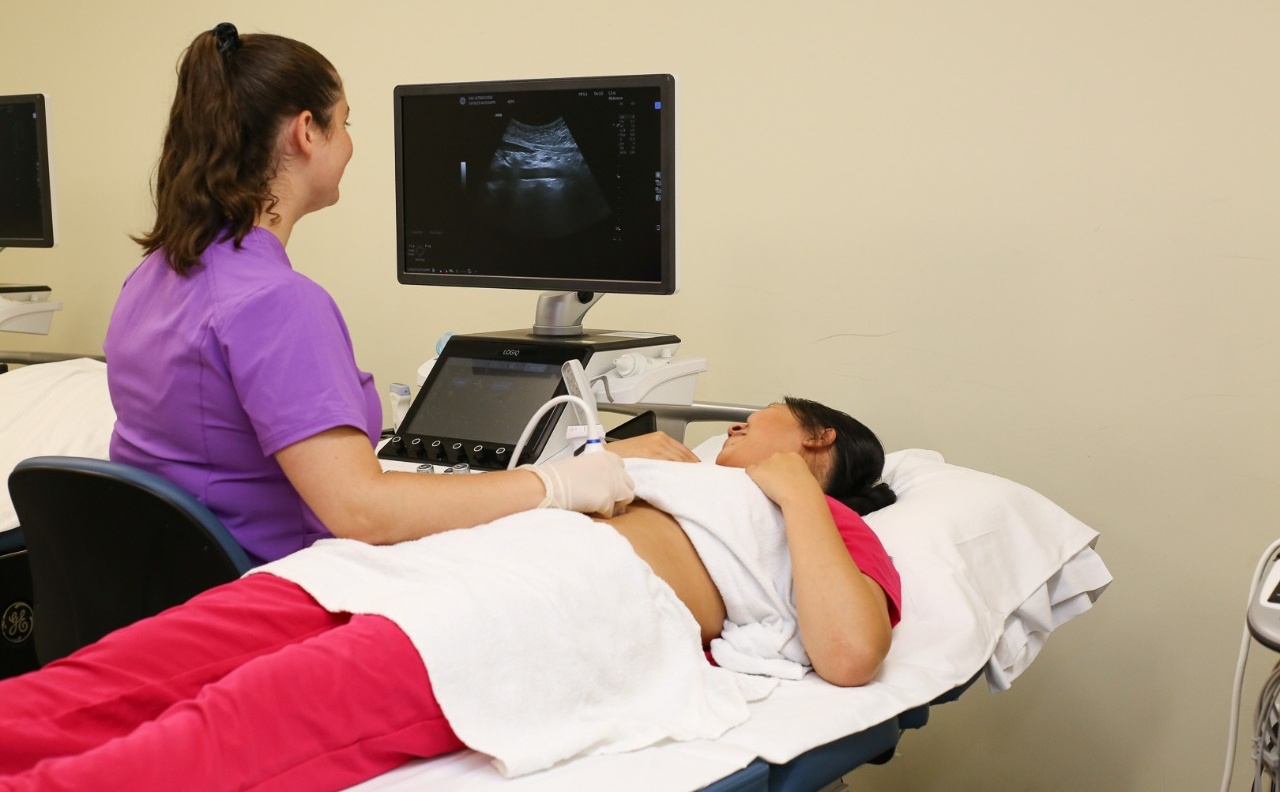
Diagnostic Medical Ultrasound Technologists (Sonographers) are highly skilled health care professionals who use ultrasound (sound waves) to look inside a patient's body, evaluate the condition of various organs and record digital pictures.
Sonographers evaluate organs and structures such as the liver, kidneys, heart, thyroid, blood vessels, muscles, ovaries and developing babies. Sonographers provide a summary of what they've discovered and discuss their findings with specialized doctors, who use this information to make a diagnosis.
How does Sonography work?
During an ultrasound examination, a sonographer uses an instrument called a transducer or probe on a patient over the area of the body under investigation. When this happens, the probe emits high-frequency sound which is inaudible to the human ear. As the probe is moved around it records echoes as the sound waves bounce back to the ultrasound machine to determine the size, shape and consistency of soft tissues and organs. Images are produced in real time and recorded for diagnostic purposes.
Sonographers also assist with ultrasound-guided interventional procedures, such as biopsies, drainages, injections and transesophageal echocardiograms.
Ultrasound exams provide key diagnostic information to doctors about a patient鈥檚 medical condition and assist in their treatment and care. Diagnostic medical ultrasounds are ordered by doctors, performed by sonographers, and interpreted and reported by a radiologist or other medical specialist with expertise in the field of ultrasound. Sonographers are medical professionals, specially trained to perform these tests.
Where do Sonographers work?
The role of the professional Sonographer is diverse and dynamic, and sonographers are active in many areas of healthcare. These allied health professionals are employed in various health care facilities. Hospitals employ all categories of sonographer; Generalist Sonographers often work in general diagnostic imaging departments; Cardiac and Vascular Sonographers may work in the cardiology or vascular units of tertiary care facilities. Clinics provide a variety of employment opportunities based on their patient care focus.
Sonographers may also become educators, application specialists or sales representatives with medical equipment companies, or be involved in research.
How do I become a Sonographer?
To become a Sonographer, individuals must attend and successfully complete an accredited Diagnostic Medical Sonography program.聽
The School of Health Sciences offers a four year Bachelor of Health Sciences (BHSc) degree program, which includes theory and practice. Students will take core professional development courses with a concentration on ultrasound specific knowledge and skills. A diploma option is possible after completion of Year 3.聽聽
Individuals who have completed the program must then write the national registration exam and meet the clinical requirements set by Sonography Canada in order to work. Those who pass the exam may use the designation "Diagnostic Medical Sonographer" (DMS).
91短视频's Diagnostic Medical Ultrasound Technology program curriculum offers the necessary competencies to challenge the Sonography Canada professional examinations.
Is Sonography right for me?
Sonography can be an excellent career for people who enjoy healthcare, technology, patient interaction, and problem-solving. It is a profession that combines technical skills with compassionate patient care.
You may be well-suited for Sonography if you:
Enjoy working with people: Sonographers interact with patients every day, often during important or emotional moments. Strong communication skills, empathy, and professionalism are essential;
Are interested in healthcare and science: A strong interest in anatomy, physiology, and how the body works is important. Sonographers must understand both normal and abnormal findings;
Have a strong attention to detail: Small details on an ultrasound image can significantly impact patient care. Careful observation and accuracy are critical.
Can think critically: Sonographers regularly make decisions in real time, adapt examinations based on findings, and solve problems independently;
Work well under pressure: Healthcare environments can be fast-paced and emotionally demanding. Sonographers need to be resilient, adaptable and maintain professionalism during stressful situations;
Value lifelong learning: Technology and medical knowledge continue to evolve. Successful sonographers are committed to ongoing learning and professional growth
You may not be well-suited for Sonography if you dislike or find it difficult to:
Work closely with people who are sick, in pain, anxious or emotionally distressed;
Pay close attention to detail for long periods of time;
Stand for long periods and perform physically demanding tasks;
Work independently while still using strong clinical judgment;
Stay calm when encountering trauma, emergencies, pregnancy complications or difficult diagnoses
What are the essential skills and attributes of a Sonographer?
A strong Sonographer combines technical ability, clinical judgment, communication skills, and professionalism. The best sonographers are not just good at scanning, but are able to help patients feel safe, gather accurate diagnostic information, and adapt quickly when situations change.
Successful Sonographers have:
A strong understanding of anatomy and physiology, technical proficiency in scanning techniques, and excellent critical thinking and problem-solving abilities. They demonstrate good attention to detail, sound clinical judgment, and adaptability in fast-paced, changing clinical environments.
Sonographers work closely with patients during vulnerable and sometimes stressful situations. Strong interpersonal skills help create a safe and supportive experience for patients. A Sonographer should be empathic and compassionate, possessing the emotional intelligence to recognize and respond to patient cues. They should have the ability to maintain professionalism during stressful situations and respond appropriately to patient emotions and concerns.
Finally, it is essential that Sonographers demonstrate professional and ethical practice they are reliable with strong organizational skills. They must be committed to lifelong learning and ongoing professional development. A Sonographer must be resilient and able to perform effectively under pressure.
For further details, please review the .
Entrance Requirements
To be considered for admission, High School applicants require grade 12 academic English, Math, Physics and Biology with no mark below 70% in each of these courses and an overall minimum average of 75%. Post-secondary applicants require a minimum GPA of 2.75 (on a 4.30 scale), with no grade lower than C in prerequisite courses.聽
The Diagnostic Medical Ultrasound Technology program accepts 16 total students annually.
1 seat in the Diagnostic Medical Ultrasound Technology program is reserved for residents from each of PEI and New Brunswick. Priority for all other seats will be given to qualified Nova Scotia residents.聽 If seats remain, residents of other maritime provinces followed by residents across Canada will be considered.
Due to residency restrictions and limited capacity, international applicants will not be considered for admission to the BHSc program.
Admission is competitive, and meeting the minimum entrance requirements does not guarantee admission.
For further details on the application process and other considerations, please review our Admissions wepbage.
Courses in the Diagnostic Medical Ultrasound Technology Program
Examples of courses in the program:
Human Anatomy & Physiology
Pathophysiology for Health Sciences
Sonography in Obstetrics
Sonography of the Abdomen and Superficial Structures
Students in the Diagnostic Medical Ultrasound Technology may also choose to complete an additional certificate in their 4th year, specializing in Cardiac Ultrasound or Vascular Ultrasound.
For full details on Clinical Education, including preclinical requirements, please review our Clinical Education webpage.
One of the benefits of studying at the School of Health Sciences is the opportunity to do hands-on clinical work. In years 1, 2, and 3, every student spends 6-8 weeks during the summer term completing a clinical practicum in a healthcare setting. In addition, third year students complete multiple clinical education courses directly in the clinical environment to help prepare them for entry to practice.聽During the clinical practicum, students may be required to work evenings, nights and weekends.
Most students complete their practicums throughout Atlantic Canada, while others travel to locations across the country. Students should be prepared to travel outside of Halifax or their home communities for their clinical placements. Placement opportunities are based on clinical site availability and are subject to change from year to year. Health Sciences students are provided with more information about availability and options before each clinical experience.
Accreditation
Accreditation Canada is the program's accrediting body. Further information can be found on , including a list of all accredited Diagnostic Medical Ultrasound (Sonography) programs within Canada.
Professional Associations
is the national professional body for Canadian Sonographers.
(formerly known as NSCMIRTP) is the Provincial Regulatory Body for Sonographers in Nova Scotia.
Registration is required to practice professionally, and members must undergo continuing professional development to maintain active registration.
Job Opportunities
Sonographers are in high demand provincially, as well as throughout Canada.
The working hours and salaries vary depending on the work setting and employer. Sonographers may be required to work (or be on call) over evenings, weekends or holidays. Starting salaries are comparable with other allied health professionals.
For current job opportunities, please visit:
Ready to apply?
Please review our Admissions webpage, which includes information on the application process, non-academic requirements, and other considerations, such as additional costs and residency eligibility.