
Interprofessional Health Education (IPE)
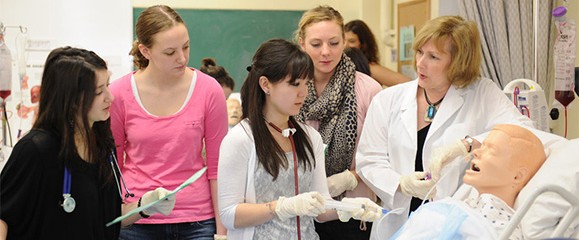
Healthcare can be complex and involve many different professionals from varying backgrounds. Interprofessional collaborative practice is necessary to provide person-centered care that addresses a person鈥檚/family鈥檚 needs without duplicating some services and letting others slip through the cracks. According to the Canadian Interprofessional Health Collaborative (CIHC), "healthcare providers who are good, interprofessional collaborative practitioners understand the importance of working together with colleagues and the patient/family.鈥� Interprofessional practice improves safety, and outcomes for patients/clients/families and improves satisfaction and decreases stress for health professionals.
Interprofessional health education (IPHE) aims to prepare professionals for interprofessional collaborative practice. According to the World Health Organization, IPHE is when 鈥渟tudents from two or more professions learn about, from, and with each other to enable effective collaboration and improve health outcomes.鈥� During their studies, audiology and speech-language pathology students will participate in interprofessional collaborative learning experiences. Some IPHE experiences are required, either within the Faculty of Health or embedded in SCSD courses, while other experiences are optional. Below you will find a list of the requirements for IPHE 5900 and tabs that list possible IPHE activities.
听
听
Resources
IPHE 5900: Interprofessional Health Education
Menu of Interprofessional Activities SCSD 2025-2026
*Please note that optional activities depend on availability and you must apply to participate. Additional activities may be included with approval from the IPHE Coordinator (Zahra Jafari)
YEAR 1:
- All students in the Faculties of Health, Medicine, and Dentistry will participate in the First Year Foundational Event where you will be introduced to IPHE and the CIHC collaborative competencies.
YEAR 2:
- CMSD 5071X/Y: ENT observations 鈥� half day ENT clinic observations with Dr. Morris at Dickson, and potentially with nurses and residents [AUD]
- CMSD 6460: Treatment of Neurogenic Language and Cognitive Disorders 鈥� Stroke IPHE including a simulated team meeting for care planning and a simulated patient encounter (includes medicine, pharmacy, physiotherapy, occupational therapy, and sometimes nursing students [SLP]
YEAR 3:
- CMSD 6611: AAC high-tech device lab 鈥� SLP and OT students explore various high tech AAC devices and work on a case to determine as a group which features are the most important to consider for their client, which 3 devices they will trial, and why [SLP]
鈥�3-2-1 offerings鈥�
- Optional experiences on a wide variety of topics that vary from year to year and semester to semester.
- May be comprised of 1, 2, or 3 meetings/events.
- Students must apply for an option and wait to be approved by the IPHE coordinator to ensure that students from a variety of professions are enrolled and that there is a natural role for each profession.
- Note: If you are applying for an offering that is of personal interest, but there is no professional role, your chances of being accepted are much lower depending on the number of students who apply for the experience. These events may not count toward your required experiences.
- Please check the website for listings and to apply for options.
*Please note that optional activities depend on availability and you must apply to participate. Additional activities may be included with approval from the IPHE Coordinator (Zahra Jafari).
YEAR 1:
- Preschool Screenings 鈥� Speech-Language Pathology, Audiology, Dental Hygiene, and Occupational Therapy students conduct preschool screenings and collaborate during team rounds听[Required - SLP/AUD]
YEAR 2 & 3:
- Practicum Placements 鈥� Students may be involved in interprofessional teams during practicum placements. If your placement includes interprofessional learning, you will count this as one experience. [SLP/AUD]
(Upload to Brightspace to submit)
Credit Hours: 0 credit hours
Instructor of Record: Zahra Jafari, PhD
Email: zahra.jafari@dal.ca
Office Hours: By appointment
Class Times & Locations: Embedded IPHE encounters may occur within the Faculty of Health (FoH) IPHE dedicated time on T/Th, 4:00 鈥� 5:30 pm, during a host CMSD course scheduled time, or during clinical practicum experiences. On occasion encounters may occur at specially scheduled times beyond class time or FoH IPHE time. Please consult your CMSD course outlines for embedded IPE details.
Course Description:
This course is comprised of interprofessional activities intended to prepare students to work in collaborative and patient/client/community/family- and relationship-focused work environments. Students in the Faculty of Health entry-to-practice graduate programs are required to maintain registration in this course for the duration of their studies.
A student must pass a minimum of 4 IPHE learning opportunities that are relevant to their program of study and must include a range of exposure and immersion level experiences to build on the CIHC IPHE competencies. At least one of these experiences must take place in a practice setting. Across these 4 learning opportunities, students must interact with at least 4 different health care professions and there must be engagement in active learning and natural role for the student鈥檚 profession (i.e., SLP or AUD).
Course Goal:
Students will develop entry-to-practice client-centered interprofessional competencies in knowledge, skills, behaviours, and attitudes through their participation in a variety of interprofessional collaborative student learning experiences where they can learn 鈥渁bout, from, and with each other鈥� (WHO, 2010). Across the required IPE experiences, students must interact with at least 4 different related professions with which there are natural affinities or linkages in professional environments.
IPHE 5900 will have a developmental approach to developing IPHE competencies and will require the student to also engage in self-directed learning for developing interprofessional knowledge, behaviours, and skills. Students are expected to take responsibility for their own learning.
Course Objectives - Adapted from:
- Demonstrate effective relationship-focused team communication with students from other professions in a cooperative, responsive, and respectful manner.
- Understand the importance for team collaboration to foster purposeful relationships among and between care/service partners and persons receiving care/services.
- Understand their own professional role and others鈥� roles to effectively establish and achieve collaborative relationship-focused care/services.
- Understand the nature of interprofessional and interdependent teamwork which includes
- Shared perspectives and decision-making for effective and efficient collaborative practice.
- Understand and articulate the value of collaborative leadership where team members value each other鈥檚 knowledge, skills, and expertise in shared decision-making and responsibilities to reach common goals.
- Understand the importance of engaging constructively in a resolution process to address team disagreements, prevent unresolved conflict, and reach an acceptable cooperative solution.
Formats:
- CMSD Host Course IPHE (required)
IPHE experiences within the curriculum will actively engage students from two or more health professions to learn about, from and with other students through diverse educational methods (e.g., laboratory sessions, case analyses, simulated client interactions, fieldwork experiences, etc.). IPHE opportunities at the School of Communication Sciences & Disorders are embedded and required within some CMSD host courses. Note: Required IPHE takes precedence over practicum; please inform your CE at the start of practicum if you have an IPHE event that overlaps with practicum. - Interprofessional 3-2-1 Experiences (optional)
Some opportunities will be available to participate in Faculty of Health IPHE 3-2-1 experiences beyond the schedule of required SLP or Audiology IPHE 5900 activities. Course descriptions, dates, and details will be posted on the , where you will also find application/registration for the optional IPHE events. You must apply for these experiences. To count toward IPHE requirements, there must be a natural role for your profession.
Notes: 1) Participation in a 3-2-1 mini course or additional IPHE event is optional and does not take priority over any required curriculum component from SCSD courses or practicum. 2) You may apply to participate in experiences that you have a personal interest in but no natural role; however, these experiences will not count toward the requirements. - Practice Experience (required)
At least one IPHE experience must take place in a practice setting, which can include a simulated practice setting. In the event there are no students from other professions in any of the student's practice settings, credit may be granted for interactions with non-student professionals; however, there must be 鈥渓earning about, with, and from鈥� the professions involved (i.e., observations without this interactive element do not count).
Technology & Software:
Access to the Internet, 91短视频 Library, word processing software, Dal e-mail, and is necessary. Please consult your host CMSD course Brightspace site. Please visit for further information regarding system requirements.
Required Reading:
Please refer to the host CMSD course outline, Brightspace for the CMSD course, or Brightspace for the IPHE experience for required readings for each IPHE opportunity. Required reading for IPHE Competencies includes:
Evaluation Methods & Grading Criteria:
Students are required to maintain registration in the course for the duration of their program of studies and complete the SCSD IPHE tracking form, which is graded by the program on a Pass/Fail basis. Grades for the course are on a Pass/Fail basis. Successful completion of this course is a requirement for graduation in all programs and will be recognized further with the awarding of a non-credit Certificate in Interprofessional Collaboration issued by the Faculty of Health.
Specific parameters of each embedded IPHE assignment will be provided by each host CMSD course instructor or event leader. Please refer to the host CMSD course instructor/leader, outline, and Brightspace site. Students must pass a minimum of 4 IPHE learning opportunities that:
- are relevant to their program of study,
- include a range of exposure and immersion level experiences,
- takes place in at least one practice setting,
- allow interaction with at least 4 different health care professions
- include engagement in active learning and a natural role for the student鈥檚 profession (i.e., SLP or AUD).
Notes: 1) Students may not claim IPHE completion for an activity where they are not actively engaged in learning 鈥渁bout, with, and from鈥� other professions, or where their profession does not have a natural role. 2) Students may take additional optional courses for their own interest but not for IPHE requirements. 3) If a student misses or fails the IPHE component of a course (but does not fail the course), it is the student鈥檚 responsibility to obtain another IPHE learning opportunity. The additional learning opportunity must be developed within a designated 鈥榩otential鈥� IPHE learning course, or another CMSD course. The student must negotiate and develop the assignment parameters with the course instructor and receive final approval from the IPHE 5900 course coordinator.
IPHE Learning Opportunities:
Please see:
- The SCSD IPHE webpage
- Course syllabi
University Policies, Statements, Guidelines:
This course is governed by the academic rules and regulations set forth in
Required Experiences
YEAR 1:
- All students in the Faculties of Health, Medicine, and Dentistry will participate in the First Year Foundational Event where you will be introduced to IPHE and the CIHC collaborative competencies.
YEAR 2:
- CMSD 5071X/Y: ENT observations 鈥� half day ENT clinic observations with Dr. Morris at Dickson, and potentially with nurses and residents [AUD]
- CMSD 6460: Treatment of Neurogenic Language and Cognitive Disorders 鈥� Stroke IPHE including a simulated team meeting for care planning and a simulated patient encounter (includes medicine, pharmacy, physiotherapy, occupational therapy, and sometimes nursing students [SLP]
YEAR 3:
- CMSD 6611: AAC high-tech device lab 鈥� SLP and OT students explore various high tech AAC devices and work on a case to determine as a group which features are the most important to consider for their client, which 3 devices they will trial, and why [SLP]
Optional Experiences
鈥�3-2-1 offerings鈥�
- Optional experiences on a wide variety of topics that vary from year to year and semester to semester.
- May be comprised of 1, 2, or 3 meetings/events.
- Students must apply for an option and wait to be approved by the IPHE coordinator to ensure that students from a variety of professions are enrolled and that there is a natural role for each profession.
- Note: If you are applying for an offering that is of personal interest, but there is no professional role, your chances of being accepted are much lower depending on the number of students who apply for the experience. These events may not count toward your required experiences.
- Please check the website for listings and to apply for options.
*Please note that optional activities depend on availability and you must apply to participate. Additional activities may be included with approval from the IPHE Coordinator (Zahra Jafari).
Practice Experiences
YEAR 1:
- Preschool Screenings 鈥� Speech-Language Pathology, Audiology, Dental Hygiene, and Occupational Therapy students conduct preschool screenings and collaborate during team rounds听[Required - SLP/AUD]
YEAR 2 & 3:
- Practicum Placements 鈥� Students may be involved in interprofessional teams during practicum placements. If your placement includes interprofessional learning, you will count this as one experience. [SLP/AUD]
IPHE Tracking Form
(Upload to Brightspace to submit)
Course Syllabus
Credit Hours: 0 credit hours
Instructor of Record: Zahra Jafari, PhD
Email: zahra.jafari@dal.ca
Office Hours: By appointment
Class Times & Locations: Embedded IPHE encounters may occur within the Faculty of Health (FoH) IPHE dedicated time on T/Th, 4:00 鈥� 5:30 pm, during a host CMSD course scheduled time, or during clinical practicum experiences. On occasion encounters may occur at specially scheduled times beyond class time or FoH IPHE time. Please consult your CMSD course outlines for embedded IPE details.
Course Description:
This course is comprised of interprofessional activities intended to prepare students to work in collaborative and patient/client/community/family- and relationship-focused work environments. Students in the Faculty of Health entry-to-practice graduate programs are required to maintain registration in this course for the duration of their studies.
A student must pass a minimum of 4 IPHE learning opportunities that are relevant to their program of study and must include a range of exposure and immersion level experiences to build on the CIHC IPHE competencies. At least one of these experiences must take place in a practice setting. Across these 4 learning opportunities, students must interact with at least 4 different health care professions and there must be engagement in active learning and natural role for the student鈥檚 profession (i.e., SLP or AUD).
Course Goal:
Students will develop entry-to-practice client-centered interprofessional competencies in knowledge, skills, behaviours, and attitudes through their participation in a variety of interprofessional collaborative student learning experiences where they can learn 鈥渁bout, from, and with each other鈥� (WHO, 2010). Across the required IPE experiences, students must interact with at least 4 different related professions with which there are natural affinities or linkages in professional environments.
IPHE 5900 will have a developmental approach to developing IPHE competencies and will require the student to also engage in self-directed learning for developing interprofessional knowledge, behaviours, and skills. Students are expected to take responsibility for their own learning.
Course Objectives - Adapted from:
- Demonstrate effective relationship-focused team communication with students from other professions in a cooperative, responsive, and respectful manner.
- Understand the importance for team collaboration to foster purposeful relationships among and between care/service partners and persons receiving care/services.
- Understand their own professional role and others鈥� roles to effectively establish and achieve collaborative relationship-focused care/services.
- Understand the nature of interprofessional and interdependent teamwork which includes
- Shared perspectives and decision-making for effective and efficient collaborative practice.
- Understand and articulate the value of collaborative leadership where team members value each other鈥檚 knowledge, skills, and expertise in shared decision-making and responsibilities to reach common goals.
- Understand the importance of engaging constructively in a resolution process to address team disagreements, prevent unresolved conflict, and reach an acceptable cooperative solution.
Formats:
- CMSD Host Course IPHE (required)
IPHE experiences within the curriculum will actively engage students from two or more health professions to learn about, from and with other students through diverse educational methods (e.g., laboratory sessions, case analyses, simulated client interactions, fieldwork experiences, etc.). IPHE opportunities at the School of Communication Sciences & Disorders are embedded and required within some CMSD host courses. Note: Required IPHE takes precedence over practicum; please inform your CE at the start of practicum if you have an IPHE event that overlaps with practicum. - Interprofessional 3-2-1 Experiences (optional)
Some opportunities will be available to participate in Faculty of Health IPHE 3-2-1 experiences beyond the schedule of required SLP or Audiology IPHE 5900 activities. Course descriptions, dates, and details will be posted on the , where you will also find application/registration for the optional IPHE events. You must apply for these experiences. To count toward IPHE requirements, there must be a natural role for your profession.
Notes: 1) Participation in a 3-2-1 mini course or additional IPHE event is optional and does not take priority over any required curriculum component from SCSD courses or practicum. 2) You may apply to participate in experiences that you have a personal interest in but no natural role; however, these experiences will not count toward the requirements. - Practice Experience (required)
At least one IPHE experience must take place in a practice setting, which can include a simulated practice setting. In the event there are no students from other professions in any of the student's practice settings, credit may be granted for interactions with non-student professionals; however, there must be 鈥渓earning about, with, and from鈥� the professions involved (i.e., observations without this interactive element do not count).
Technology & Software:
Access to the Internet, 91短视频 Library, word processing software, Dal e-mail, and is necessary. Please consult your host CMSD course Brightspace site. Please visit for further information regarding system requirements.
Required Reading:
Please refer to the host CMSD course outline, Brightspace for the CMSD course, or Brightspace for the IPHE experience for required readings for each IPHE opportunity. Required reading for IPHE Competencies includes:
Evaluation Methods & Grading Criteria:
Students are required to maintain registration in the course for the duration of their program of studies and complete the SCSD IPHE tracking form, which is graded by the program on a Pass/Fail basis. Grades for the course are on a Pass/Fail basis. Successful completion of this course is a requirement for graduation in all programs and will be recognized further with the awarding of a non-credit Certificate in Interprofessional Collaboration issued by the Faculty of Health.
Specific parameters of each embedded IPHE assignment will be provided by each host CMSD course instructor or event leader. Please refer to the host CMSD course instructor/leader, outline, and Brightspace site. Students must pass a minimum of 4 IPHE learning opportunities that:
- are relevant to their program of study,
- include a range of exposure and immersion level experiences,
- takes place in at least one practice setting,
- allow interaction with at least 4 different health care professions
- include engagement in active learning and a natural role for the student鈥檚 profession (i.e., SLP or AUD).
Notes: 1) Students may not claim IPHE completion for an activity where they are not actively engaged in learning 鈥渁bout, with, and from鈥� other professions, or where their profession does not have a natural role. 2) Students may take additional optional courses for their own interest but not for IPHE requirements. 3) If a student misses or fails the IPHE component of a course (but does not fail the course), it is the student鈥檚 responsibility to obtain another IPHE learning opportunity. The additional learning opportunity must be developed within a designated 鈥榩otential鈥� IPHE learning course, or another CMSD course. The student must negotiate and develop the assignment parameters with the course instructor and receive final approval from the IPHE 5900 course coordinator.
IPHE Learning Opportunities:
Please see:
- The SCSD IPHE webpage
- Course syllabi
University Policies, Statements, Guidelines:
This course is governed by the academic rules and regulations set forth in