

This article first appeared in the .
Monica Brown has a pain in her stomach, a fist-sized passenger stowed away behind her belly button. Its effects, which are constant and vary only in intensity, include an agonizing swelling that Brown calls 鈥淭he Bloat.鈥� It is not a simple tummy-ache or the result of any commonly understood affliction like cancer or gastrointestinal illness. Since it escalated in severity at age 13, Brown鈥檚 pain has defied easy explanation and denied her a normal life, forcing her to miss months of school at a time.
Al Isnor, on the other hand, knows exactly what caused him to hit 鈥渞ock bottom鈥� several years ago at 24: Tourette鈥檚 Syndrome, with symptoms including such violent jerking of his head and neck that he required medication for the resulting pain. Isnor鈥檚 symptoms were threatening the steady hands he required in his woodworking job and despite trying countless medications and treatments, he hadn鈥檛 found any lasting relief.
Two different ailments. Two desperate patients. But after years of pain and frustration, Brown and Isnor were able to tap into the network of 91短视频 medical research. Their lives were about to get better.
Unravelling mysteries
When Dr. Christine Chambers met Brown a decade ago, she saw a young girl suffering from both debilitating pain and the anguish of not knowing its cause. 鈥淚t鈥檚 hard enough to be a teenager when you don鈥檛 have any health challenges,鈥� says Dr. Chambers. 鈥淭hen you layer on a mysterious disease, which is really what pain is.鈥�
In addition to treating patients like Brown, Dr. Chambers is a Canada Research Chair in Pain and Child Health working out of the Centre for Pediatric Pain Research at the IWK Health Centre. Thanks to her efforts and those of her colleagues, 91短视频 has become recognized as an international leader in pediatric pain research.
鈥淲hat we know about pain now is that it鈥檚 a very complex biological and psychological experience,鈥� says Dr. Chambers. 鈥淧ain is an alarm system that鈥檚 supposed to go off when something in your body is wrong, but just like alarms can go off for no reason or be overly sensitive, that can happen in your pain system.鈥�
Armed with that knowledge, Dr. Chambers worked with Brown with the hope of helping her manage her pain in a healthy way. With Dr. Chambers鈥� guidance, Brown found some relief in yoga, breathing and meditation, as well as medication. By explaining her research, Dr. Chambers also gave Brown the words to tell friends and family how she felt. Perhaps most importantly, Brown found in Dr. Chambers someone who could listen and understand.
鈥淚t was the first time in my life I felt believed.鈥�
In contrast to the steady, incremental gains made by most medical researchers, Dr. Chambers says the field of pediatric pain lends itself to quick transitions between discovery and care. Her research into how parents respond to children in pain, for example, has already yielded new recommendations for parents, which Dr. Chambers has conveyed in a TEDx Talk and through . 鈥淲hen parents try to offer reassurance, kids pick up on the fact that their parents are nervous and that anxiety seems to make the pain worse.鈥�
Because pain research isn鈥檛 expressly tied to defeating a single major disease, Dr. Chambers says the field doesn鈥檛 generate much awareness or many resources. She says that in her field, bridging and matching funds can be essential to continuing important research or getting new research off the ground. For researchers working grant to grant, bridge funds can keep projects afloat between grants. Matching funds allow researchers to aim higher by seeking out research opportunities partially funded by external parties.

Dr. Christine Chambers (right) with Monica Brown.
鈥淭hose types of funding are absolutely critical for researchers like myself who might be going from one grant to another, or who have an idea for something interesting and innovative but might need matching funds to make it happen,鈥� says Dr. Chambers.
From the basics to the benefits
鈥淎l had exhausted all other avenues and his life was becoming a living nightmare,鈥� says Sandy Isnor of the moment a little more than seven years ago when Al walked into neurosurgeon Dr. Robert Brownstone鈥檚 office. Now Al鈥檚 wife, Sandy was at the time his long-distance girlfriend.
One of Dr. Brownstone鈥檚 specialties is the implantation of deep-brain stimulation (DBS) devices in people suffering from tremor and movement disorders. He says it is rare for someone with Tourette鈥檚 Syndrome to have symptoms so severe that they require this kind of procedure, so when Al Isnor walked through Dr. Brownstone鈥檚 door he knew he was, by definition, dealing with a serious case.
According to Al, Dr. Brownstone explained the DBS surgery in a way that was easy to understand, which helped Al make the decision to go forward with it. Within a few months of the procedure, both Al and Sandy noticed his symptoms decreasing in frequency and intensity. 鈥淚t was like seeing a different person in front of me,鈥� Sandy says.
Dr. Brownstone knows that the distance between basic research discovery and practical application is often measured in years, even decades. He works on both ends of this timeline, operating on patients like Al Isnor while also studying the fundamental circuitry of the nervous system as the principal investigator at 91短视频鈥檚 Motor Control Lab.
鈥淗opefully what I do [in the lab] will help patients 20 or 30 years from now,鈥� he says. Dr. Brownstone is building toward breakthroughs in our understanding of how movement works. He studies four distinct groups of circuits: those between the spinal cord and the muscles; those within the spinal cord; the 鈥渃ommand circuits鈥� between the brain and the spinal cord; and the 鈥渄ecision-making鈥� circuits in the upper levels of the brain. Researching at this fundamental level, Dr. Brownstone describes himself as 鈥渄isease-agnostic,鈥� in that he is not targeting particular illnesses. 鈥淭he hope is that some of these discoveries will have applications for many different diseases.鈥�
Like most medical researchers, Dr. Brownstone has benefitted from technological advances and ever-improving equipment. As an example, he cites cellular molecular digital imaging microscopes, which allow researchers to see fine details that their predecessors could never have imagined. The need for top technology is behind the 91短视频 Medical Research Foundation鈥檚 (DMRF) Core Facilities Fund, a resource that is used to acquire and maintain advanced equipment that can be used by multiple researchers and departments.
鈥淭hese facilities are absolutely critical and the only way we can support them is institutionally,鈥� says Dr. Brownstone.
Having the best technology at his disposal will help Dr. Brownstone change future patients鈥� lives through his research. In the meantime, he makes an immediate impact for patients like Al Isnor as a neurosurgeon.
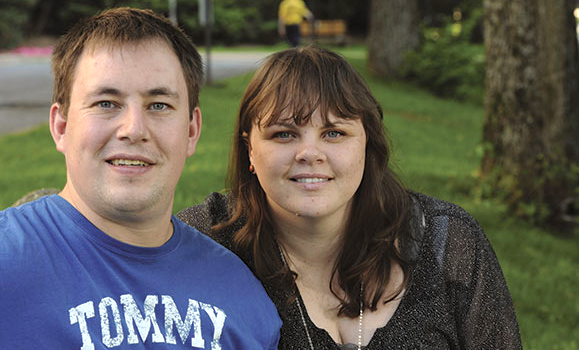
Al Isnor with his wife Sandy.
Living better
The term 鈥渕edical research鈥� conjures up the idea of lifesaving new treatments and cures, major diseases wiped out in flashes of brilliant insight, and 91短视频 has contributed a great deal in the fight against killers like cancer and heart disease. Dr. Tom Marrie, Dean of Medicine at 91短视频, points to the work of Dr. Patrick Lee, who has pioneered a virus that can be implanted into鈥攁nd destroy鈥攃ancer cells. Dr. Marrie also notes that 91短视频鈥檚 cardiology research team is renowned for expertise about heart rhythm.
91短视频 researchers have also shown leadership in fields that support quality of life. Dr. Brownstone and Dr. Chambers are two examples, working with patients suffering from chronic illnesses. And as better treatment allows more people to survive serious conditions, the need has further grown to examine quality-of-life concerns. Whether the research is aimed at curing major diseases or bolstering scientific knowledge, saving lives or making them better, each aspect feeds the other.
鈥淭hese little things that each lab discovers, other labs learn from that and it just keeps going,鈥� says Alison Edwards, executive director of the DMRF. 鈥淭hat鈥檚 why health research matters.鈥�
Al Isnor and Monica Brown don鈥檛 need convincing. Theirs are just two lives that have been improved by medical research and 91短视频 researchers. Now 32, Isnor is married to Sandy. He鈥檚 been driving for the past five years after previously staying away from the wheel because of his symptoms. Whereas once he couldn鈥檛 sit still through a movie or a plane ride, he is now an enthusiastic traveller who has visited Toronto, New York and South Africa. His condition requires minimal management, including an annual procedure to change the batteries in his deep brain stimulation device. 鈥淢y quality of life has gone from zero to 1,000 in seven years,鈥� he says.
At 23, Brown is in the Bachelor of Education program at Mount Saint Vincent University and gives speeches through the IWK that promote understanding of pain as a chronic illness. Dr. Chambers and the team of clinicians and researchers she collaborates with continue to give Brown the tools to manage her pain, for which Brown is grateful. 鈥淚 don鈥檛 know where I鈥檇 be without Dr. Chambers and her dedication to her research and her patients.鈥�